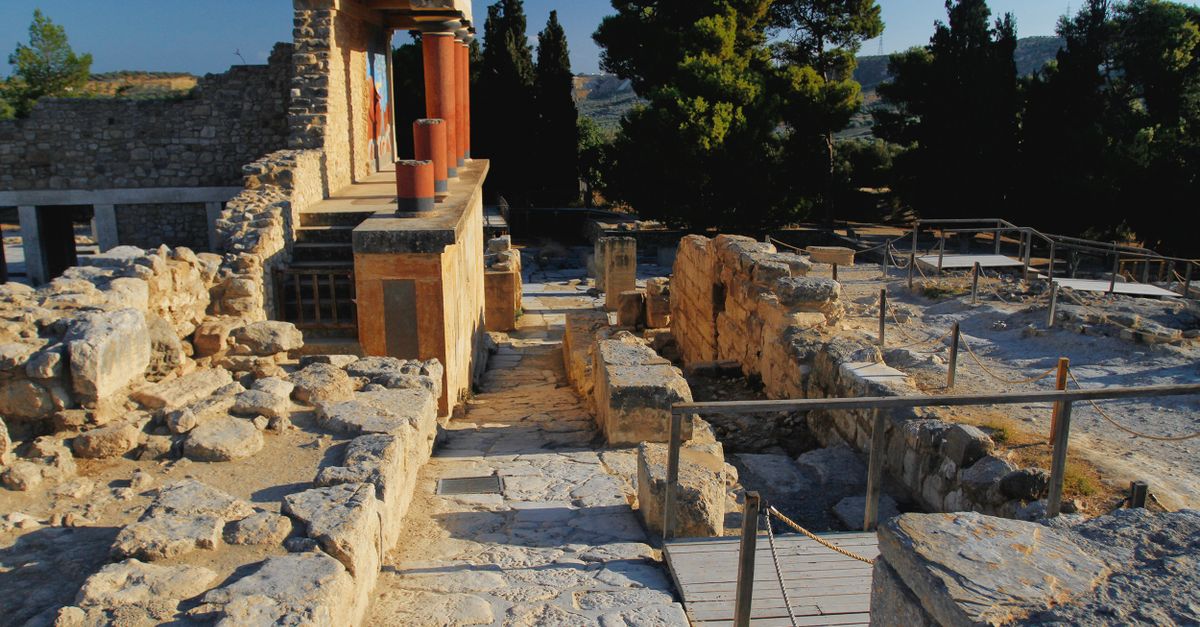
Knossos
Photo: Сокіл Sokil / Pexels
The Verdict
Recommended — the great Minoan palace and the oldest European civilization's capital, with the caveat that reconstructions are controversial.
Why go
Knossos is the physical anchor for the Bronze Age Aegean and the political center of the Minoan world. Walking the site means navigating a labyrinthine multi-level complex of limestone foundations, lightwells, and storage magazines lined with massive ceramic pithoi. Arthur Evans's early-twentieth-century concrete reconstructions—complete with vivid, speculative restorations of the frescoed walls and painted downward-tapering columns—remain polarizing among archaeologists, but they make the vertical scale and spatial layout immediately legible in a way few Aegean ruins manage. A visit requires navigating significant tour-bus congestion and exposed limestone paths that trap heat by mid-morning. You move between the Central Court, the throne room with its carved gypsum seat, and the domestic quarters, tracing the complex drainage systems and administrative rooms of a civilization that flourished four millennia ago. Pair the visit directly with the Heraklion Archaeological Museum in town, where the original frescoes, the snake goddess figurines, and the delicate artifacts reside; seeing one without the other leaves the picture half-finished.
Understand the place
Bronze Age palace of Europe's first advanced civilization, legendary seat of King Minos. The reconstructions are controversial, but the scale still impresses.
Nearby
Related
Sources
Booking links
Commercial links: we may earn a commission if you book through them, at no extra cost to you.
Plan this trip
Greece Field Guide helps you decide. When you're ready to arrange it, take your saved places to an itinerary.