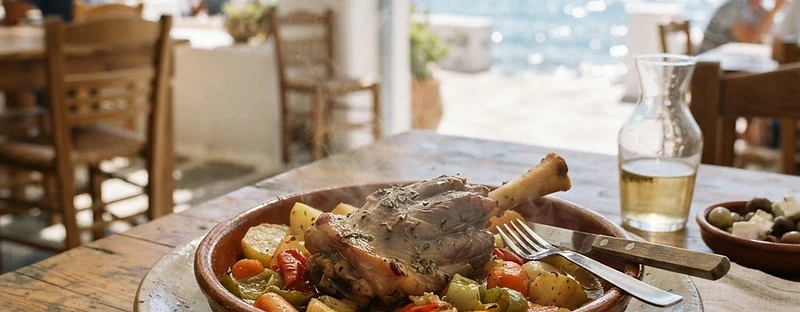
Kleftiko
Photo: Greece Field Guide
The Verdict
Meat cooked 'thief-style' that delivers incredible tenderness.
Why go
Kleftiko belongs to mountain tavernas and Sunday tables where time is not a constraint. The method traces back to Greek guerrillas and bandits who cooked stolen meat in sealed earth pits to avoid sending up telltale smoke. In modern kitchens, the earth pit becomes parchment paper or foil, sealed tight around bone-in lamb, whole garlic cloves, lemon juice, olive oil, and dried oregano. Often potatoes, peppers, or slabs of salty kefalotyri cheese join the parcel, absorbing the rendered fat over several hours of low-heat roasting. When the parcel is cut open at the table, steam releases a sharp hit of garlic, citrus, and wild oregano. The meat retains none of the tough elasticity common to quickly grilled chops; it slips off the bone under the pressure of a fork, rich with rendered collagen. The trade-off is its sheer heaviness. This is not seaside lunch fare meant to precede an afternoon swim. It demands crusty bread to drag through the concentrated juices, a cold dry white or resinous retsina to cut through the tallow, and an unstructured afternoon afterward. Quality varies wildly depending on cut and patience. Cheap versions rely on lean pieces that dry out despite the wrap, or sit warm for hours under heat lamps. It is best ordered in villages known for pastoral livestock—in the Peloponnese, Crete, or the Pindus mountains—at establishments that roast a finite batch each day
Understand the place
Lamb slow-roasted with garlic, lemon, and oregano, sealed in parchment until it falls apart. Thief-style cooking that delivers tenderness without any real effort.
Keep reading
The food & drink guideMore dishes in Greece
Plan this trip
Greece Field Guide helps you decide. When you're ready to arrange it, take your saved places to an itinerary.