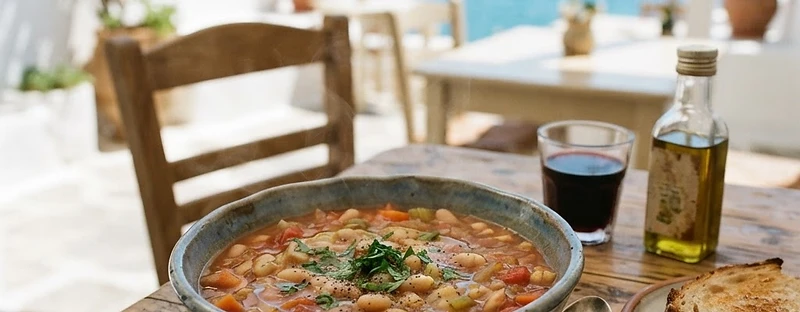
Fasolada
Photo: Greece Field Guide
The Verdict
The national soup of Greece; simple, hearty, and fundamentally honest.
Why go
Fasolada is Greece's undisputed national dish, though you will rarely see it advertised to tourists on coastal promenades. It is peasant fuel refined over centuries: medium or large dry white beans simmered slowly with celery, carrots, onions, and sometimes a grating of tomato paste until the broth turns thick and starchy. The defining element is the olive oil, poured in near the end of cooking with an abandon that startles outsiders. It emulsifies with the bean starch into a rich, golden broth that carries herbal sharpness from the celery leaves and sweet depth from the softened carrots. It belongs to autumn and winter, eaten at midday in mountain tavernas, worker canteens, and family dining rooms. The ritual around the bowl matters as much as the soup itself. Fasolada is never eaten in isolation; it demands raw red onion wedges, brine-cured black kalamata olives, pickled wild peppers, and salted fish such as smoked herring or anchovies to cut the starch and fat. A thick slab of crusty sourdough bread is mandatory for wiping the bowl clean. The trade-off is its utter lack of theatricality. If you judge food by visual flash or elite technique, fasolada will look like plain brown gruel. But a taverna that cannot balance the olive oil and aromatics in its fasolada cannot be trusted with roasted lamb or fish either. It is the uncompromising baseline of everyday Greek cooking.
Understand the place
White beans, carrots, celery, and heavy olive oil make Greece's national soup. Humble, filling, and the honest baseline against which every taverna's cooking should be measured.
Keep reading
The food & drink guideMore dishes in Greece
Plan this trip
Greece Field Guide helps you decide. When you're ready to arrange it, take your saved places to an itinerary.