Greece for Wine Lovers

Editorial collection

Greece for Wine Lovers

10 min read · 8 places

Who This Trip Serves

This is not a guide for someone who orders the house white because the list is in Greek and they're hungry. It's for the traveler who already knows what tannin feels like on day three of a bottle, who has opinions about malolactic fermentation, and who wants a Greece trip organized around a liquid instead of a beach. Greece makes this possible in a way few people realize: Assyrtiko, Xinomavro, and Agiorgitiko are not regional curiosities, they are world-class grapes that happen to be criminally under-ordered outside their own country.

The five places in this collection — Santorini, Naoussa, Nemea, Crete, and Samos — are not a greatest-hits tour of Greek scenery with wineries bolted on. They're a deliberate arc through the country's wine identity: volcanic white, tannic mainland red, friendly mainland red, sprawling island complexity, and sweet fortified coda. The three grapes that follow — Assyrtiko, Xinomavro, Malagousia — are the vocabulary you need to make sense of everything you just drank.

What ties it together is seriousness without solemnity. Santorini doesn't need you to perform reverence; it needs you to taste what ash and pumice do to acidity. Naoussa doesn't care if you've heard of Xinomavro before you got there — it will teach you fast, and the lesson involves tannin that bites back. This is a trip for people who want their palate rearranged, not confirmed.

If you came here looking for a soft introduction to rosé on a boat, this isn't it. That trip exists elsewhere. This one assumes you'll leave knowing the difference between a Nykteri and a Vinsanto, and why that matters.

Santorini Leads For A Reason

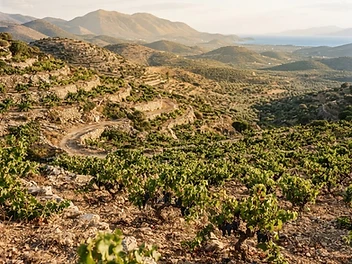
Santorini opens this list because it has to. Without the island's Assyrtiko, there is no case for building a trip around Greek wine — it's the single wine most likely to already be on a serious list in London or New York, and tasting it where the kouloura-trained vines coil along the ground against the meltemi wind reframes everything you thought you knew about it. This is the proof point. Everything after it is building on credibility Santorini has already established.

That's also why it comes before the mainland reds rather than after. You need the white first — high-acid, saline, unmistakably volcanic — to understand what Greek wine is capable of before you walk into something as demanding as Naoussa. Santorini is accessible in a way Naoussa isn't: approachable on arrival, rewarding immediately, no patience required. It's the correct front door.

The island's PDO rules matter here too — ungrafted vines, some over a century old, phylloxera having never reached the volcanic soil. That's not trivia, it's the reason the wine tastes the way it does, and it's why Santorini earns top billing over regions that are arguably more complex but less immediately legible to a newcomer.

Skip Santorini and the entire premise of this collection collapses. Everything else is secondary to this one stop.

Two Reds, Two Temperaments

Naoussa comes second because it's the hardest thing on the list, and difficulty belongs early while your palate is still fresh and your expectations are still being formed. Xinomavro — the name literally means "acid-black" — produces wine that argues with Nebbiolo for structural seriousness: high acid, real tannin, a need for cellar time that most tourists never give it. Visiting Naoussa means tasting wines that are often closed and unglamorous in youth, and that's the point. This is Greece's most demanding wine region, and demanding should come before comfortable.

Nemea follows deliberately as the release valve. Agiorgitiko — sometimes called the Blood of Hercules, with more marketing flourish than the wine needs — is warmer, rounder, more immediately generous than Xinomavro. Visiting Nemea right after Naoussa lets you feel the contrast directly: two mainland reds, two completely different temperaments, back to back. Sub-zones like Koutsi produce something close to Nemea's answer to a grand cru; Asprokampos is friendlier and earlier-drinking. That range mirrors the journey from Naoussa's austerity to Nemea's ease.

Putting Nemea before Naoussa would have been a mistake — you'd calibrate to softness and find Xinomavro punishing by comparison instead of appreciating its intent. The order teaches you to read structure before you're handed comfort.

Together these two stops make the case that Greek reds deserve the same attention routinely given to Rhône or Piedmont. Most visitors never make it to either. That's the gap this collection exists to close.

Breadth, Then A Quiet Close

Crete sits fourth because it refuses to be a single appellation story, and by this point in the trip you've earned the right to get lost in something sprawling. This is the largest Greek island and its own wine ecosystem — Vidiano, Liatiko, Kotsifali, four overlapping PDOs around Peza, Dafnes, Archanes, and Sitia — a revival happening in real time rather than a finished product like Santorini's. It's messier, less codified, and that's exactly the value: after the tight discipline of Naoussa and Nemea, Crete opens the aperture and shows you a wine culture still arguing with itself about what it wants to be.

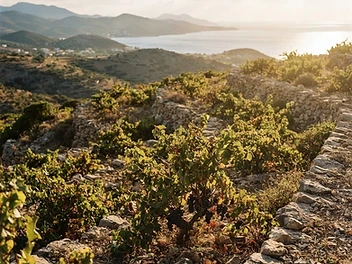
Samos closes the place-based half of this list for a different reason: it's the comedown, deliberately. After four stops built around dry, structured, serious wine, Samos pivots to something sweeter and slower — Muscat Blanc à Petits Grains grown on terraced hillsides, mostly funneled through the cooperative that still dominates production there. The sweet Samos Nectar and fortified styles aren't a lesser category, they're a different register, and ending the geographic leg of the trip here lets you leave on something indulgent rather than another round of tannin analysis.

This also mirrors classic tasting-menu logic: structure builds, then releases. Naoussa and Nemea are the entrées. Crete is the wildcard course. Samos is dessert, and it's placed last among the destinations because dessert should never come before the main event.

If you only have four stops in you, this is the one to cut — not because Samos is lesser, but because it's the most removable without damaging the argument the rest of the trip makes.

The Glossary, And What To Cut

The final three entries — Assyrtiko, Xinomavro, Malagousia — aren't places, and they're not meant to be visited. They're reference material, deliberately placed last so you read them with the destinations already in your memory rather than as dry theory beforehand. Assyrtiko comes first in this trio because it mirrors Santorini's position at the front of the whole list: the grape that makes the entire project legible. Xinomavro follows for the same reason Naoussa follows Santorini — it's the second pillar, the one that proves Greek wine isn't just a white-wine story.

Malagousia closes the entire collection, and that placement is the most deliberate one here. It has no single home region the way Assyrtiko has Santorini or Xinomavro has Naoussa — it was nearly extinct until Vangelis Gerovassiliou rescued a handful of vines near Thessaloniki in the 1970s and 80s, and it's now grown everywhere from Epanomi to Crete. It belongs last because it's not a monument, it's a signal: Greek wine is still being rewritten, and the next bottle that changes the conversation hasn't been identified yet.

One honest gap: Agiorgitiko, Nemea's defining grape, doesn't get its own glossary entry. That's intentional, not an oversight — Nemea's place note carries that weight, and three grape profiles kept this list tight rather than turning it into a varietal encyclopedia.

Use this list in order on a first pass. If you're cutting for time, lose Samos first, then Crete if you need to go further — but never cut Santorini, Naoussa, or the grape notes, because those three pieces are what make the rest of the trip make sense instead of just taste good.

The list, in order

Each place, with the editorial reason it is here and in this position.

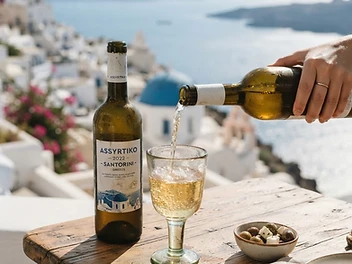
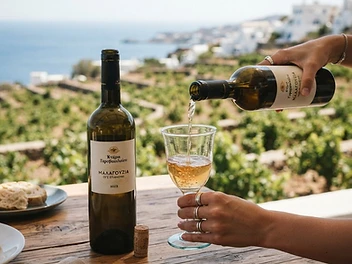
A bottle of Assyrtiko white wine with a filled glass on a wooden table, against a brick wall.
wine regionEssential

“Essential if you drink wine — the volcanic Assyrtiko grown on Santorini is among the world's great white wines, and the reason wine belongs in a Greece trip.”

Why this, why here

This is the anchor, full stop. Without Santorini's Assyrtiko, there's no credible argument for building a Greece trip around wine — it's the one wine on this list most likely to already carry weight on a serious international list, and tasting it against the island's pumice soil and ungrafted, century-old vines reframes the whole category. It opens the collection because it's the most immediately legible wine here: high acid, saline, unmistakable, no patience required to appreciate it. Everything that follows — the tannic demands of Naoussa, the sprawl of Crete, the sweetness of Samos — is measured against the credibility this stop establishes first. Cut this and the entire premise collapses.

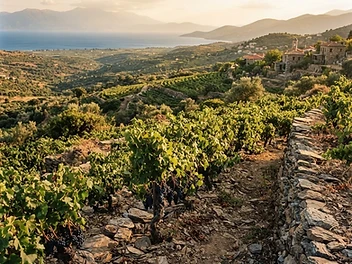
Naoussa, a wine region from Greek Macedonia, Greece
wine regionEssential

“The spiritual home of Xinomavro and the most demanding wine region in Greece.”

Why this, why here

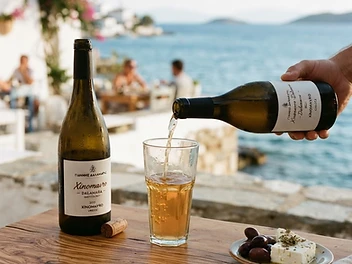
Naoussa comes second because difficulty belongs early. Xinomavro here produces wine closer in spirit to Nebbiolo than to anything else on a typical Greek wine list — real tannin, real acid, a genuine need for cellar time most visitors never grant it. This is the most demanding wine region in Greece, and putting it right after Santorini's immediate charms forces a recalibration: good wine isn't always easy wine. It's placed before Nemea deliberately, so the contrast lands — austerity first, generosity second. Skip it only if you've already decided this is a soft trip, in which case you've picked the wrong collection.

Nemea, a wine region from Peloponnese, Greece
wine regionEssential

“The premier appellation for Agiorgitiko, and the red-wine region most worth a detour.”

Why this, why here

Nemea is the release valve after Naoussa, and it's positioned immediately after it for that exact contrast. Agiorgitiko is warmer and rounder than Xinomavro, more forgiving in youth, easier to love on first pour — and tasting it right after the mainland's hardest region lets you feel two completely different red-wine temperaments back to back rather than reading about them. Sub-zones like Koutsi show how serious Nemea can get when it wants to; Asprokampos shows how approachable. This is the premier appellation for Agiorgitiko, and its place in the sequence exists specifically to teach contrast, not just quality.

Crete, a wine region from Crete, Greece
wine regionEssential

“A massive, diverse island that acts as its own distinct wine ecosystem.”

Why this, why here

Crete sits fourth because it refuses to behave like a single appellation, and by this point in the trip you've earned something sprawling. After the tight discipline of Naoussa and Nemea, Crete opens the aperture — Vidiano, Liatiko, Kotsifali, four overlapping PDOs, a revival still arguing with itself about direction. It's the wildcard course, placed deliberately between the structured mainland reds and the sweet island coda of Samos. This is where the trip stops being a checklist of singular appellations and starts being a genuine ecosystem. If you need to cut for time, this goes second, after Samos — but losing it means losing the trip's one real curveball.

The orange roofs of Kokkari on Samos, above the sea with hills behind.
islandBase

“The greenest and most mountainous of the big east Aegean islands: vineyards, a great temple in the flat land, and beaches at the end of gorges.”

Why this, why here

Samos closes the place-based half of this collection on purpose — after four stops of dry, structured, serious wine, it's the comedown. Muscat Blanc à Petits Grains, mostly cooperative-produced, delivering sweet and fortified styles that shift the register entirely rather than asking for more tannin analysis. Ending the geographic leg here mirrors tasting-menu logic: structure builds, then releases into dessert. It's also the first cut if you're shortening this trip — removable without damaging the argument the rest of the list makes, precisely because its job is indulgence, not proof. Last among destinations, first on the chopping block.

Assyrtiko, a wine from Cyclades, Greece
wineEssential

“This is the king of Greek white grapes, delivering high acidity and electric minerality.”

Why this, why here

The glossary opens with Assyrtiko for the same reason the trip opened with Santorini: it's the grape that makes the whole project legible. This entry exists to arm you with what you tasted on the island but couldn't fully articulate — the acidity, the saline minerality, the reason phylloxera-free volcanic vines produce something genuinely singular. It's placed first among the three grape notes deliberately, mirroring Santorini's position at the front of the destination list. Read this after visiting, not before — it'll make more sense that way, and it sets the bar the other two grape profiles have to meet.

Xinomavro, a wine from Greek Macedonia, Greece
wineEssential

“A structural powerhouse often compared to Nebbiolo for its tannins and aging potential.”

Why this, why here

Xinomavro follows Assyrtiko in the glossary for the same reason Naoussa followed Santorini on the ground: it's the second pillar, proof that Greek wine isn't only a white-wine story. This note exists to give you the vocabulary for what Naoussa put you through — the tannin, the acid, the Nebbiolo comparisons that get thrown around too casually but aren't wrong. It's structural and often unglamorous young, and understanding that before you buy a bottle to age matters more here than almost anywhere else on this list. Second position, mirroring Naoussa's place in the trip, is not an accident.

Malagousia, a wine from Greek, Greece
wineEssential

“Once nearly extinct, this grape is now the star of the modern Greek revival.”

Why this, why here

Malagousia closes the entire collection, and that's the most deliberate placement here. Unlike Assyrtiko or Xinomavro, it has no single home region — nearly extinct until Vangelis Gerovassiliou rescued a handful of vines near Thessaloniki decades ago, now grown from Epanomi to Crete. It closes the list because it's not a monument like the other two, it's a signal: Greek wine is still being rewritten, and the grape that defines the next decade hasn't been settled yet. Ending on Malagousia rather than a more famous name is the editorial point — this collection bets on momentum, not just pedigree.