Islands We'd Choose for a First Greece Trip

Editorial collection

Islands We'd Choose for a First Greece Trip

10 min read · 4 places

The Trip This Guide Actually Serves

This is the loop for someone who has never been to Greece and might not go back for a decade, so every stop has to earn its place. Not the backpacker doing eleven islands in two weeks, not the honeymoon couple with unlimited budget and no interest in ferry schedules — the regular traveler with seven to ten days, a reasonable budget, and one shot to get it right. They want the caldera photo. They want a real beach. They want a meal that isn't moussaka reheated for tourists. They do not want to spend three of their ten days standing in port terminals wondering if the fast ferry is actually fast.

That traveler's instinct is usually wrong in a specific way: they think more islands equals more Greece. It doesn't. It equals more transit, more luggage logistics, more mornings lost to checkout times and ferry windows. Four stops — Athens, Santorini, Naxos, Paros — is not a compromise version of a bigger trip. It's the version that actually works, because each stop does a job the others can't, and the whole thing can be done on a single Blue Star or SeaJets routing without backtracking.

What ties these four together is that none of them are filler. Athens is not a layover. Santorini is not just the famous photo. Naxos and Paros are not interchangeable "other Cyclades islands" you swap in because you ran out of days. Each has a specific job: context, spectacle, substance, convenience. Cut any one of them and the trip gets worse in an identifiable way, not just shorter.

This is also, bluntly, a guide for people who are going to actually go to Greece once and want it to be good, not a guide for completists. If you've already done Athens-Santorini-Mykonos twice and want the Dodecanese or the Peloponnese, this isn't your list. This is the list you hand a friend who says "we're thinking Greece next summer" and has never opened a map of the Aegean.

What They Share, What They Don't

All four places sit within a few hours of each other by boat or short flight, which is the unglamorous but decisive reason this works as a first trip. Athens connects to both Santorini and the Cyclades hub islands by high-speed ferry in under five hours, and Paros sits almost equidistant between Naxos and Santorini, which is why it closes the loop instead of just dead-ending it. This isn't a thematic pairing dreamed up for narrative neatness — it's a routing that minimizes dead travel time, which matters enormously when you've only got a week and change.

Beyond logistics, they share a baseline: real beaches, real food, real old-town walking, not manufactured tourist infrastructure. But the differences are the actual point. Athens is urban, dense, historical, and occasionally ugly in the way real cities are ugly — it has nothing to do with the other three except that it's where international flights land and where the Acropolis happens to be. Santorini is spectacle: caldera, sunset, volcanic geology that genuinely looks different from anywhere else in the Aegean, at a price and crowd level that makes two nights the right dose, not four. Naxos is scale and range — a big enough island that you get mountain villages, Venetian architecture, and beach towns without ever feeling like you're on a film set. Paros is the connector: good enough to stand on its own for two days, but mainly valuable because it's the most efficient base for getting everywhere else.

What none of them have is nightlife-as-main-event. Mykonos isn't on this list, deliberately. If someone's first Greece trip is primarily about beach clubs and late-night scenes, this isn't their itinerary — go write that guide separately. This one assumes the traveler wants the version of Greece that holds up in memory ten years later: a meal in a Naxos mountain village, a caldera sunset that actually lives up to the photos, the first glimpse of the Parthenon lit up at night.

Why This Specific Order

The sequence is not arbitrary and it is not alphabetical — it's a build, and it's also a route, and those two things happen to align, which is why this itinerary works better than most people's first instinct.

Athens goes first because you need the context before the spectacle. Three days in Athens — the Acropolis Museum, Plaka at night, the National Archaeological Museum if you have the stamina — gives you the historical frame that makes the islands mean more, not less. It also absorbs your jet lag and any flight delays before you're dependent on ferry timing. Front-loading Athens is non-negotiable: do it at the end of the trip and you'll be too tired, too sunburned, and too eager to get to the airport to give the city its due.

Santorini comes second, immediately after Athens, because it's the emotional peak and peaks shouldn't sit in the middle of a trip getting buried by everything after them. Two nights, not four — this is a deliberate rationing. Santorini's crowds and prices punish overstaying, and the caldera view doesn't improve on day three the way a Naxos village meal improves with a second or third evening. You get the postcard, you get Oia at sunset once, and you move on while it's still vivid rather than souring from overexposure.

Naxos is third because after Santorini's intensity, you need the island that lets you actually relax and eat well without a crowd of cruise-ship day-trippers at every taverna. This is the substance stop — the one that proves Greece isn't just caldera views, it's also a grandmother's kitchen in Halki and a near-empty beach at Plaka. It's positioned in the middle of the trip deliberately, as the longest, least rushed stretch, because by day five or six you've earned unhurried.

Paros comes last not because it's the weakest link but because it's the exit ramp — close enough to Athens's airport ferry and flight connections to make the final return simple, with just enough of its own character (Naoussa's harbor, Lefkes up in the hills) to make the last 36 hours feel like a destination rather than a layover. Ending on Paros rather than Naxos or Santorini is a logistics call disguised as a soft landing.

What To Cut If You're Short

If you have five days instead of eight or nine, cut Naxos first, not Athens and not Santorini. This will feel wrong to people who've read that Naxos is the "best all-around" island, and it is — but this is a first trip, and first trips are allowed to prioritize icons over balance. Do Athens for two days, Santorini for two, Paros for one as your exit, and you still have a coherent, satisfying trip. You've just traded the deepest, most well-rounded stop for raw time.

If you have even less — four days, a long weekend bolted onto a work trip to Athens — cut Paros too and make Santorini your only island. It's not as good a trip; it's missing the beach-and-village texture that makes Greece more than a volcano crater and a sunset bar. But it's honest about what four days can actually deliver, and it beats cramming all four stops into a blur where you remember nothing specific about any of them.

Do not, under any circumstance, cut Athens to buy more island time. This is the most common mistake first-time planners make, and it's backwards. Two extra island nights will blur together in memory; the Acropolis at golden hour will not. Athens is cheap relative to Santorini lodging, the museums are extraordinary, and skipping it to save two days is optimizing for the wrong currency.

How To Actually Use This

Treat the order as the default route, not a suggestion menu to shuffle. If you're going to deviate, deviate on day counts within each stop, not on sequence — don't put Naxos before Santorini, don't end on Santorini instead of Paros, because the emotional and logistical logic breaks down. The sequence front-loads context, peaks early with spectacle, settles into substance, and closes with convenience. Reverse any part of that and you either exhaust yourself before the climax or end the trip on an anticlimax.

Book the inter-island ferries before you land, not after — July and August sailings between these four points sell out, and the whole point of this route is avoiding logistical stress, not creating new flavors of it. Blue Star Ferries and SeaJets both run this corridor reliably; check both.

Finally, resist the urge to add a fifth island because someone told you about Milos or Folegandros. This guide is deliberately not comprehensive. It's four stops that work as a system. Add a fifth and you're not enriching the trip, you're diluting the time that makes Naxos's slow afternoons and Athens's late dinners actually land. Save Milos for the second trip — there will be a second trip, that's rather the point of getting this one right.

The list, in order

Each place, with the editorial reason it is here and in this position.

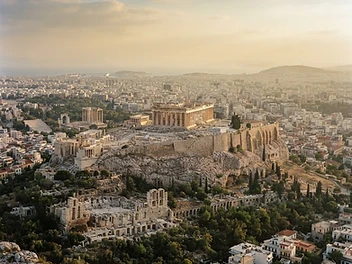
The Acropolis and Parthenon above Athens
cityTrip Anchor

“Don't treat Athens as the airport before the islands — two or three days here genuinely improves most Greece trips.”

Why this, why here

Athens is the anchor, not a layover to tolerate before the "real" trip starts — and it goes first in the sequence for a reason: the Acropolis Museum and the Plaka give every island stop afterward a historical frame it wouldn't otherwise have. It also soaks up jet lag and flight delays before you're beholden to ferry windows. People routinely shortchange Athens to two nights or skip it entirely to buy island time; that's the single most common mistake in first-Greece planning. Put it first, give it three full days, and the rest of the trip gets better, not worse, for the investment.

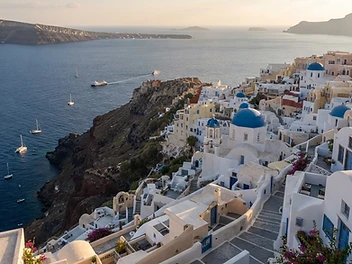
Santorini caldera village with blue domes above the Aegean
islandTrip Anchor

“The caldera really is extraordinary. The crowds and pricing are real too. Two nights is enough for many Greece itineraries.”

Why this, why here

Santorini sits second because it's the emotional peak, and peaks belong early — bury the caldera sunset in the middle of a trip and everything after it feels like a letdown. Two nights, deliberately rationed: long enough for Oia at golden hour and a wine-country afternoon in Pyrgos, short enough to dodge the worst of the crowd fatigue and the price creep that punishes longer stays. This is the icon stop, the one that delivers the postcard your friends expect to see. It's not the best island here for food or pace — that's coming next — but no first Greece trip earns its keep without it.

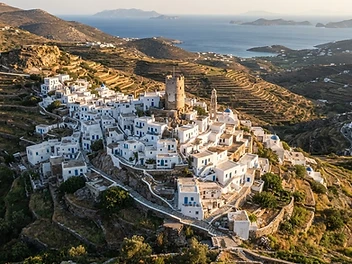
Cycladic mountain village in Naxos above the Aegean
islandBase

“One of the strongest all-around Cycladic islands if you want beaches, mountain villages and excellent food without Santorini's spectacle or Mykonos's nightlife focus.”

Why this, why here

Naxos is the substance stop, positioned third and given the most unhurried stretch of the trip because by day five or six, slower is what the traveler actually needs. After Santorini's intensity and expense, Naxos proves Greece isn't only caldera views — it's a taverna in Halki, Portara at sunset without a tour bus in sight, mountain villages that have nothing to perform for anyone. It's also the first cut if the itinerary gets compressed: losing Naxos costs you range and depth, not the trip's core identity. Keep it if you can. It's the stop most likely to be the thing people talk about years later.

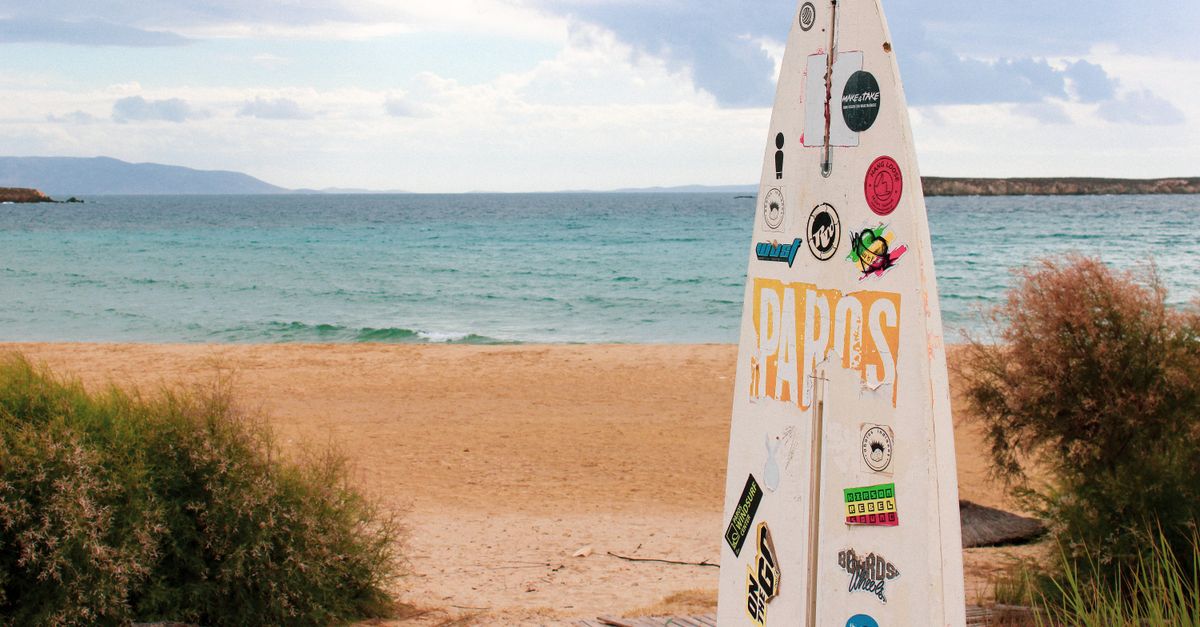
A surfboard with stickers on Paros beach with cloudy skies and a tranquil sea.
islandBase

“The most convenient base for Cyclades island hopping, with enough of its own character to stand alone.”

Why this, why here

Paros closes the loop, and it closes it for a logistics reason as much as a scenic one: it's the most convenient position for the return to Athens's airport or port, with Naoussa's harbor and the hill town of Lefkes giving the last 36 hours its own identity instead of feeling like a layover. It's the come-down by design — lower intensity than Santorini, less demanding than Naxos's sprawl — a soft landing before flights home. Cut it under time pressure and the trip still works, but you lose the easy exit and have to route straight back through Athens or Naxos instead, adding friction exactly where you want none.